The Cisco Certified Network Professional Service Provider (CCNP SP) certification is a prestigious credential in the IT industry, validating expertise in designing, implementing, and managing advanced service provider IP networks. To earn this certification, candidates must master complex topics like MPLS, QoS, BGP, OSPF, ISIS, and network architecture—all of which are tested through rigorous exams.
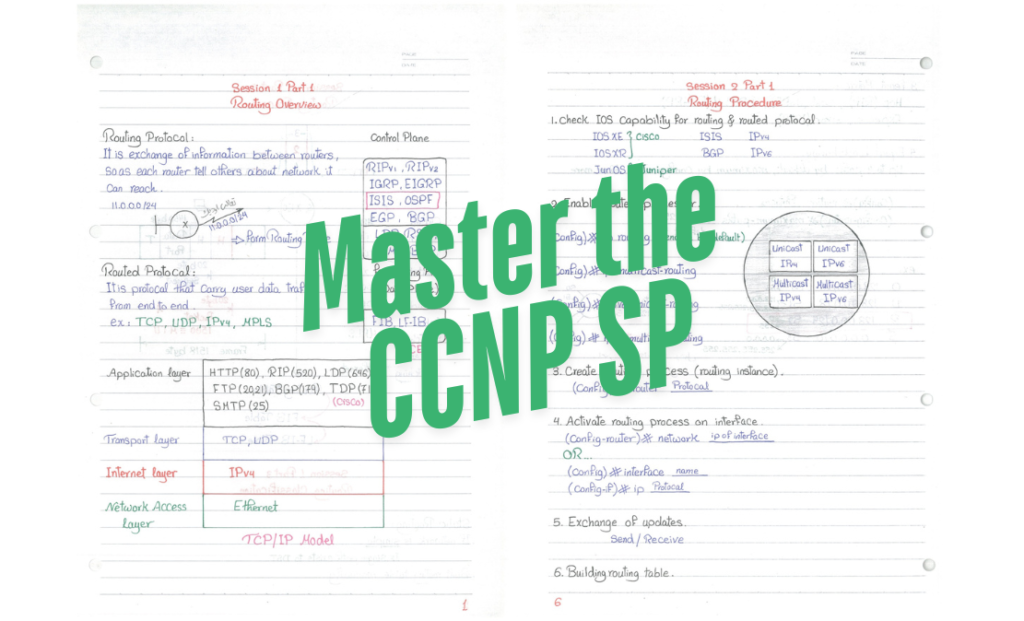
While many learners rely on digital study tools, traditionalists often prefer handwritten notes for deeper retention and personalized learning. To bridge this gap, we’ve created a free CCNP SP Handwritten Notes PDF—a printable, customizable resource designed to help you highlight key concepts, jot down insights, and study at your own pace.
Why Use Handwritten Notes for CCNP SP Prep?
- Active Engagement: Writing reinforces memory and understanding.
- Flexibility: Print, annotate, and organize notes to fit your learning style.
- Comprehensive Coverage: All exam topics are structured in a clear, logical flow.
What’s Inside the CCNP SP PDF Guide?


The guide breaks down the certification’s core domains into digestible sections:
1. Routing Fundamentals
- Routing Overview (Protocols, Tables, Classification)
- Static vs. Dynamic Routing
- Multicast Routing
- Best Path Selection & Load Balancing
2. OSPF & ISIS Deep Dives
- OSPF: Single/Multi-Area Configurations, LSAs, Redistribution, Sham Links
- ISIS: OSI Addressing, Routing Levels, Operation Modes, Configuration
3. BGP Mastery
- BGP Tables, Messages, and Path Selection
- Route Reflectors, Confederations, and Advanced Case Studies
- Multihoming, Synchronization, and AS Translations
4. MPLS & VPN Technologies
- MPLS Basics (Labels, Forwarding, LDP/TDP)
- Layer 2/3 VPNs (VRF, VPLS, EVPN)
- MPLS Traffic Engineering and QoS
5. Advanced Topics
- Route Filtering, Redistribution, and Administrative Distance
- Network Architecture for Service Providers
CCNP Service Provider: How the Certification Works
To earn CCNP Service Provider you pass two exams: the core exam 350-501 SPCOR (Implementing and Operating Cisco Service Provider Network Core Technologies) and one concentration exam of your choice, such as advanced routing (SPRI) or VPN services (SPVI). Exam names and codes change from time to time, so confirm the current list on Cisco’s website.
| Area | What you need to know | In these notes |
|---|---|---|
| IGP routing | OSPF and IS-IS design, areas and levels, redistribution | Sections 1, 2 and 5 |
| BGP | Path selection, route reflectors, confederations, multihoming | Section 3 |
| MPLS | Labels, LDP, forwarding, traffic engineering | Section 4 |
| VPN services | L3VPN with VRFs and MP-BGP, L2VPN, VPLS and EVPN | Section 4 |
| QoS and architecture | QoS models, SP network design | Sections 4 and 5 |
Key Concepts Candidates Often Mix Up
- Route Distinguisher vs. Route Target: the RD makes customer prefixes unique inside MP-BGP. The RT controls which VRFs import and export which routes.
- IS-IS Level 1 vs. Level 2: Level 1 routes within an area, Level 2 routes between areas (the backbone). L1/L2 routers connect the two.
- Route reflector vs. confederation: both solve the iBGP full-mesh problem. A route reflector re-advertises iBGP routes to clients; a confederation splits one AS into smaller sub-ASes.
- LDP vs. RSVP-TE: LDP distributes labels that follow the IGP best path. RSVP-TE builds traffic-engineered tunnels along explicit paths.
- VPLS vs. EVPN: both deliver multipoint Layer 2 services. EVPN uses BGP to learn MAC addresses in the control plane and supports active-active multihoming.
Frequently Asked Questions
Do I need the CCNA before CCNP Service Provider?
There is no formal prerequisite, but solid CCNA-level routing and switching knowledge is strongly recommended before starting.
How should I practice CCNP SP labs?
Use EVE-NG, GNS3 or Cisco Modeling Labs with IOS XR and IOS XE images. Build a small MPLS core first, then add L3VPN, then BGP route reflectors. Our MPLS VPN Practical Labs PDF is a good companion.
How to Use This Guide Effectively
- Print & Personalize: Highlight key terms and add your own annotations.
- Focus on Weak Areas: Use the structured sections to target gaps in knowledge.
- Pair with Labs: Complement theory with hands-on practice (e.g., GNS3/EVE-NG).
Download Your Free CCNP SP Handwritten Notes PDF
Ready to streamline your study process? 👉 Click Here to Download the PDF 👈
Final Tips for CCNP SP Success
- Combine this guide with Cisco’s official curriculum and practice exams.
- Join study groups or forums to discuss complex topics like MPLS TE or BGP confederations.
- Schedule consistent study sessions—consistency beats cramming!
Good luck on your CCNP SP journey! 🚀
Related Free Networking Resources
- Cisco SDWAN Interview Questions and Answers PDF
- Implementing VRF, MPLS VPN & MP-BGP: Comprehensive Guide PDF
- MPLS Networking Handwritten Guide PDF
- MPLS VPN Practical LABs PDF
- Master the Art of Subnetting: 45 Practice Questions & Answers (PDF)
- 48 VLAN MCQ and Answers with Explanations