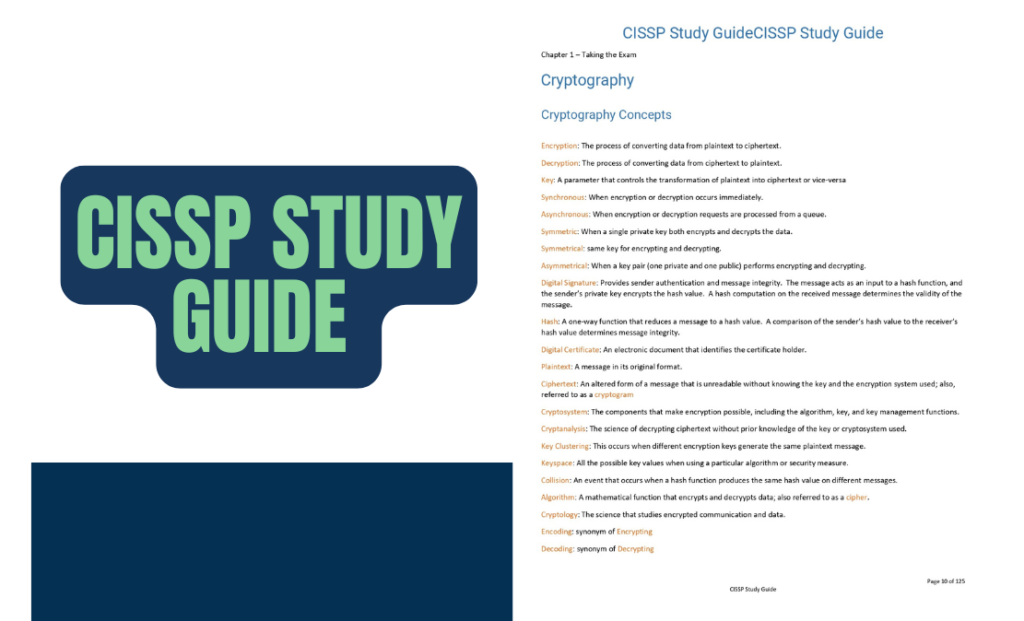
Are you preparing for the Certified Information Systems Security Professional (CISSP) exam? If so, you’re likely searching for a comprehensive and reliable study guide that covers all the topics and domains of this prestigious certification. The CISSP exam is one of the most challenging certifications in the field of information security, requiring significant effort and dedication to pass. However, with the right resources and strategies, you can achieve your goal and become a certified professional.
In this blog post, we’ll introduce you to an invaluable CISSP Study Guide PDF that contains detailed notes on the 10 domains of the classic CISSP CBK, mapped below to the current 8 exam domains. This guide is based on the official (ISC)² CISSP Common Body of Knowledge (CBK) and is designed to help you review and reinforce your understanding of the exam objectives. We’ll also provide an overview of its content, highlight key topics, and share a link to download it for free.
Overview of the CISSP Study Guide PDF
The CISSP Study Guide PDF is a concise yet thorough resource spanning 126 pages, covering each of the 10 domains of the classic CISSP CBK. It is organized logically and presented in an easy-to-follow format, making complex concepts simpler to grasp. Key features include:
- Definitions: Clear explanations of technical terms.
- Examples: Practical illustrations to clarify abstract ideas.
- Diagrams & Tables: Visual aids to enhance comprehension.
- Key Points & Tips: Important reminders to focus on during exam preparation.


What You Should Know
- The CISSP Study Guide PDF is not intended as a replacement for the official (ISC)² CISSP CBK or other reference materials. Instead, it serves as a supplementary tool to help you review and revise what you’ve already learned from primary sources.
- While it can significantly boost your confidence, passing the exam ultimately depends on your overall preparation and understanding of the material.
The guide follows the classic 10-domain layout of the CBK. The topics are still core exam material, and the table further down shows where each chapter fits in the current 8-domain outline.
Content of the CISSP Study Guide PDF
The guide covers all Topics of the CISSP exam, ensuring no critical topic is overlooked. Here’s a breakdown of the domains included:
Table of Contents
Chapter 1 – Taking the Exam
Chapter 2 – Cryptography
- Cryptography Concepts
- Cryptography History
- Cryptosystem Features
- Encryption Systems
- Substitution Ciphers
- Symmetric Algorithms
- 5 Modes of DES
- Triple DES (3DES)
- Advanced Encryption Standard (AES)
- International Data Encryption Algorithm (IDEA)
- Skipjack, Blowfish, Twofish, RCA/ARC4, RC5, RC6, CAST
- Asymmetric Algorithms
- Diffie-Hellman, RSA, El Gamal, ECC, Knapsack, Zero Knowledge Proof
- Message Integrity
- Hash Functions
- Message Digest Algorithms
- Digital Signatures
- Public Key Infrastructure (PKI)
- Key Management
Chapter 3 – Physical Security
- Threat Mitigation Techniques
- Geographical, Man-Made, Political, and Natural Threats
- Site and Facility Design
- Layered Defense Model
- Crime Prevention Through Environmental Design (CPTED)
- Facility Selection Issues
- Computer and Equipment Rooms
- Perimeter Security
- Barriers/Bollards, Fences/Gates, Intrusion Detection Systems, Lighting
- Building and Internal Security
- Doors, Glass Entries, Interior Considerations
- Secure Data Centers and Fire Detection Systems
- Environmental Security, Fire Detection
- Types of Power Issues
- Dirty Power Protection
- HVAC Guidelines
- Equipment Security and Personal Security
Chapter 4 – Security Architecture and Design
- Security Model Concepts
- System Architecture
- Computing Platforms, Virtual Computing
- Security Services and System Concepts
- CPU, RAM, ROM, Memory Concepts
- Security Models
- Bell-LaPadula, Biba, Clark-Wilson
- Security Modes and Evaluation
- ITSEC Ratings, Common Criteria, Certification/Accreditation
- Security Architecture Threats
- XML Concerns, Database/Distributed Systems Security
Chapter 5 – Access Control
- Access Control Concepts
- Defense in Depth, Identification/Authentication
- Authentication Factors (Passwords, Biometrics)
- Authorization Concepts
- Federated Identity, User Accountability
- Vulnerability Assessment
- Penetration Testing, Threat Modeling
- Access Control Models and Administration
- Access Control Monitoring and Threats
- Password/Social Engineering Threats
Chapter 6 – Software Development Security
- System Development Life Cycle (SDLC)
- Testing, Validation, Best Practices
- Software Development Methods
- Programming Languages and Concepts
- Database Security and Threats
- Malware and Protection
Chapter 7 – Information Security Governance and Risk Management
- Security Frameworks and Methodologies
- Risk Assessment and Asset Valuation
- Security Governance Components
- Policies, Data Classification, Roles
- Personnel Security, Training, Budgeting
Chapter 8 – Telecommunications and Network Security
- OSI Model Layers (Application to Physical)
- TCP/IP Model and Encapsulation
- Networking Concepts (IP Addressing, Topologies, Protocols)
- Network Devices and Security
- Hub
- Switch
- Other Devices
- Firewall Architectures
- Cloud Computing
- Network Types
- WAN Technologies
- OC Lines SONET
- CSU/DSU
- Circuit Switching vs. Packet Switching
- Additional WAN Technologies
- VOIP Security
- Remote Connection Technologies
- Dial-Up
- Cable
- VPN Components
- IPsec Components
- RADIUS and TACACS
- Remote Authentication Protocols
- Wireless Networks
- 802.11 Techniques
- Cellular or Mobile Wireless Techniques
- WLAN 802.11 Standards
- Short Range
- WLAN Security Models
- Network Cable Threats
- ICMP Attacks
- DNS Attack
- Email Attacks
- Wireless Attacks
- Other Attacks
Chapter 9 – Operations Security
- Concepts
- Protecting Tangible and Intangible Assets
- Facilities
- Hardware
- Software
- Asset Management
- Media Management
- Storage Options
- Storage Management Issues
- Sanitizing and Disposing of Data
- Network and Resource Management
- Incident Response Management Steps
- Change Management
- Audit and Review
- Threats and Preventative Measures
- System Hardening
- Monitoring and Reporting
Chapter 10 – Business Continuity and Disaster Recovery
- Concepts
- BIA Development
- Identify Critical Processes and Resources
- Identify Outage Impacts and Estimate Downtime
- Identify Resource Requirements
- Identify Recovery Priorities
- Business Continuity Scope and Plan
- Preventive Controls
- Create Recovery Strategies
- Categorize Asset Priority
- Data Recovery Terms
- Critical Terms and Duties
- BCP Testing
Chapter 11 – Legal, Regulations, Investigations, and Compliance
- Digital Crime
- Major Legal Systems
- Privacy
- Personally Identifiable Information (PII)
- Laws and Regulations
- European Union (EU)
- Liability
- Incident Response
- Forensics and Digital Investigations
- Security and Professional Ethics
Appendices
- Current CISSP Domains
Key Topics to Focus On
While the CISSP exam covers a wide range of subjects, some topics are tested more frequently than others. To maximize your chances of success, prioritize these key areas:
- The CIA Triad and Security Principles: Confidentiality, Integrity, Availability.
- Security Models and Frameworks: NIST, ISO/IEC 27001, COBIT, etc.
- Security Policies, Standards, Guidelines, and Procedures: Understanding their roles and differences.
- Risk Management Process and Methodologies: Threat identification, vulnerability assessment, risk mitigation.
- Security Controls and Countermeasures: Technical, administrative, and physical controls.
- Access Control Models and Mechanisms: Discretionary Access Control (DAC), Mandatory Access Control (MAC), Role-Based Access Control (RBAC).
- Software Development Life Cycle (SDLC) and Security Best Practices: Secure coding practices, testing methodologies.
- Network Security Concepts and Protocols: Firewalls, intrusion detection systems, secure communication protocols.
- Business Continuity and Disaster Recovery Planning: Incident response plans, recovery time objectives (RTO), recovery point objectives (RPO).
- Legal and Ethical Issues and Regulations: HIPAA, GDPR, PCI-DSS, and more.
These topics form the backbone of the CISSP exam. Mastering them will give you a solid foundation to tackle even the toughest questions.
How This Guide Maps to the Current 8 CISSP Domains
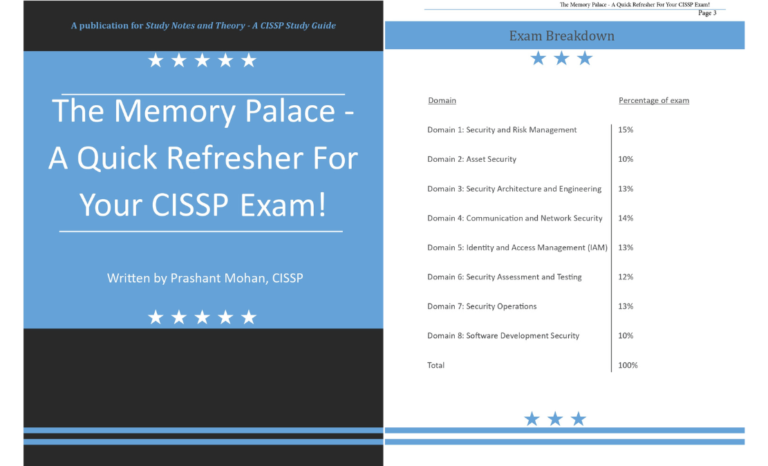
The chapters in this PDF follow the classic 10-domain structure of the CISSP CBK. The current exam outline groups the same knowledge into 8 domains. The material is still very relevant; it is just organized differently. Use this table to find the right chapters for each current domain:
| Current CISSP domain | Where to study it in this PDF |
|---|---|
| 1. Security & Risk Management | Chapter 7 (Governance & Risk Management), Chapter 10 (Business Continuity), Chapter 11 (Legal, Regulations & Ethics) |
| 2. Asset Security | Chapter 7 (data classification, roles), Chapter 9 (asset and media management, sanitizing and disposing of data) |
| 3. Security Architecture & Engineering | Chapter 2 (Cryptography), Chapter 3 (Physical Security), Chapter 4 (Security Architecture & Design) |
| 4. Communication & Network Security | Chapter 8 (Telecommunications & Network Security) |
| 5. Identity & Access Management | Chapter 5 (Access Control: authentication, authorization, federated identity, access control models) |
| 6. Security Assessment & Testing | Chapter 5 (vulnerability assessment, penetration testing), Chapter 9 (audit and review) |
| 7. Security Operations | Chapter 9 (Operations Security, incident response, change management), Chapter 10 (Disaster Recovery), Chapter 11 (forensics and investigations) |
| 8. Software Development Security | Chapter 6 (SDLC, development methods, database security, malware) |
For the latest official domain list and weights, always check the current exam outline on the ISC2 website.
A 10-Week CISSP Study Plan Using This PDF
| Week | Focus | Chapters |
|---|---|---|
| 1 | Exam format, security governance and risk | 1, 7 |
| 2 | Legal, regulations, ethics and investigations | 11 |
| 3 | Cryptography | 2 |
| 4 | Security architecture, models and physical security | 3, 4 |
| 5 | Network security | 8 |
| 6 | Identity and access management | 5 |
| 7 | Security operations | 9 |
| 8 | Business continuity and disaster recovery | 10 |
| 9 | Software development security | 6 |
| 10 | Full review and practice exams | All |
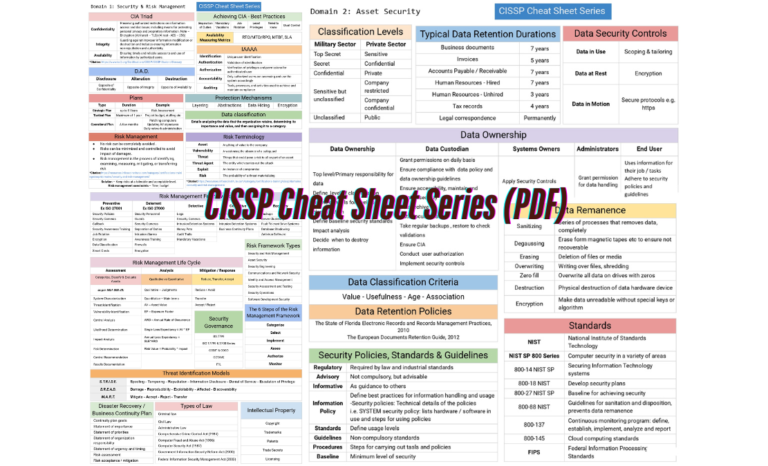
Each week, read the chapter, write your own one-page summary, and finish with practice questions on that topic. In the last week, review with the CISSP Cheat Sheet Series for a fast pass over all 8 domains.
Concepts Candidates Most Often Confuse
- Due care vs. due diligence: due diligence is researching and planning what should be done. Due care is actually doing it.
- Policy, standard, procedure, guideline: a policy is high-level and mandatory, a standard is a specific mandatory requirement, a procedure gives step-by-step instructions, and a guideline is a recommendation.
- Bell-LaPadula vs. Biba: Bell-LaPadula protects confidentiality (“no read up, no write down”). Biba protects integrity (“no read down, no write up”).
- RPO vs. RTO vs. MTD: RPO is how much data you can afford to lose. RTO is how quickly a system must be restored. MTD is the maximum time the business can survive the outage.
- Symmetric vs. asymmetric encryption: symmetric (AES, 3DES) uses one shared key and is fast. Asymmetric (RSA, ECC, Diffie-Hellman) uses a key pair and is used for key exchange and digital signatures.
- Hot, warm and cold sites: a hot site is ready almost immediately, a warm site has equipment but needs data and setup, and a cold site is just space and power.
Frequently Asked Questions
Is this CISSP study guide still useful for the current exam?
Yes, as a review resource. The core topics (cryptography, access control, network security, risk management, BCP/DR, operations) are still tested. The guide uses the older 10-domain layout, so use the mapping table above and pair it with the current official outline.
How long does it take to prepare for the CISSP?
Most candidates study for two to four months, depending on their experience. The 10-week plan above is a realistic schedule for someone already working in security.
What is the best way to use a CISSP PDF guide?
Read actively: summarize each chapter in your own words, focus on why a control is chosen rather than memorizing lists, and test yourself with practice questions after every chapter.
Is the PDF free?
Yes. You can download the full 126-page PDF for free from the link below.
Download the CISSP Study Guide PDF
Ready to get started? Click the button below to download the CISSP Study Guide PDF for free. Compatible with any device, this file can be printed or saved to your cloud storage for easy access.
Download CISSP Study Guide PDF From Here
We hope this guide proves helpful in your journey toward becoming a CISSP-certified professional. Good luck with your studies, and let us know how you progress!
Related Free Cybersecurity Resources
- CISSP Concepts Guide (PDF)
- CISSP Refresher Guide PDF
- CISSP Cheat Sheet: Ultimate Study Companion
- CISSP Security Assessment and Testing PDF: Your Comprehensive Guide
- IoT CyberSecurity Framework PDF
- CompTIA Security SY0-701 Exam Study Guide PDF