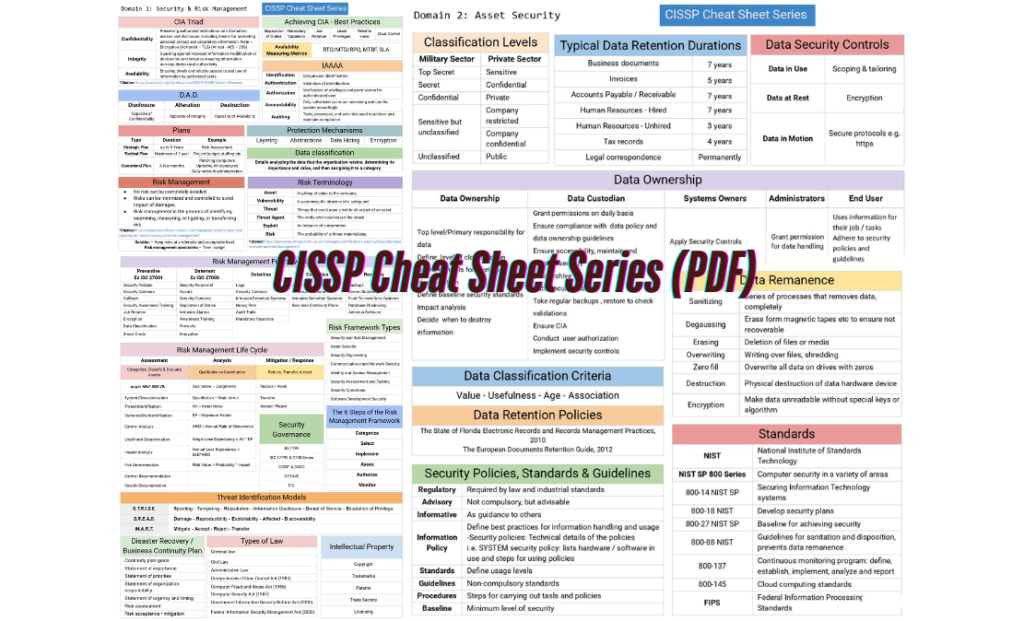
Conquer All 8 CISSP Domains with Condensed, Expert-Crafted Notes
The CISSP certification is the gold standard for cybersecurity professionals, but its vast curriculum can feel overwhelming. Cut through the noise with the CISSP Cheat Sheet Series PDF—a razor-focused, 8-page guide designed to simplify your exam prep. Whether you’re days away from the test or just starting your journey, this resource is your tactical ally for mastering critical concepts at lightning speed.
Why This Cheat Sheet?
- Condensed Precision: No fluff—only the most exam-relevant topics for all 8 CISSP domains.
- Quick Reference: Perfect for last-minute review, flashcards, or on-the-go study sessions.
- Expert Insights: Curated by cybersecurity professionals who’ve aced the exam.
What’s Inside the 8 Sheets?


Each sheet targets a key CISSP domain, breaking down complex ideas into digestible bullet points:
- Domain 1: Security and Risk Management
Governance, compliance, risk assessment (quantitative/qualitative), and business continuity. - Domain 2: Asset Security
Data classification, encryption, retention policies, and secure disposal. - Domain 3: Security Architecture and Engineering
Cryptography, security models (Biba, Bell-LaPadula), and cloud security. - Domain 4: Communication and Network Security
Secure protocols (TLS, IPsec), network design (firewalls, VPNs), and attack mitigation. - Domain 5: Identity and Access Management (IAM)
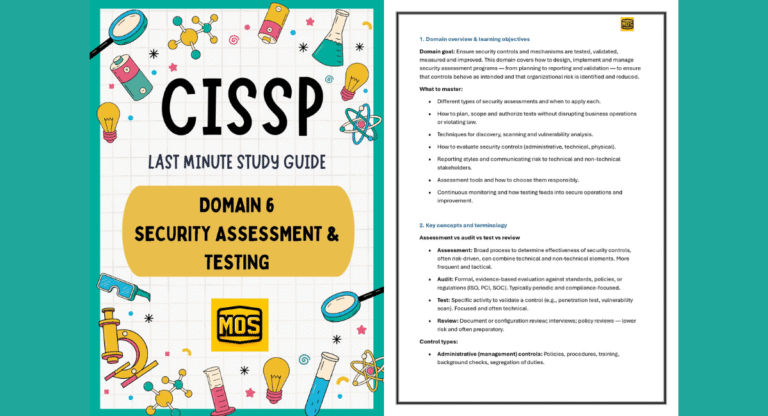
MFA, RBAC/ABAC, privilege management, and federated identities. - Domain 6: Security Assessment and Testing
Vulnerability scans, penetration testing, and audit methodologies. - Domain 7: Security Operations
Incident response, disaster recovery, and digital forensics. - Domain 8: Software Development Security
Secure SDLC, OWASP Top 10 (SQLi, XSS), and code review best practices.
Who Is This For?
- CISSP Candidates: Reinforce domain knowledge and identify weak spots.
- Busy Professionals: Refresh core concepts during work breaks.
- Study Groups: Use as discussion prompts or quick quizzes.
Why 8 Sheets?
The CISSP CBK’s depth demands focus. This guide distills 1,000+ pages of content into 8 laser-focused sheets that:
- Highlight key definitions (e.g., CIA triad, least privilege).
- Provide actionable checklists (e.g., steps for risk assessment).
- Summarize exam-critical frameworks (e.g., ISO 27001, NIST).
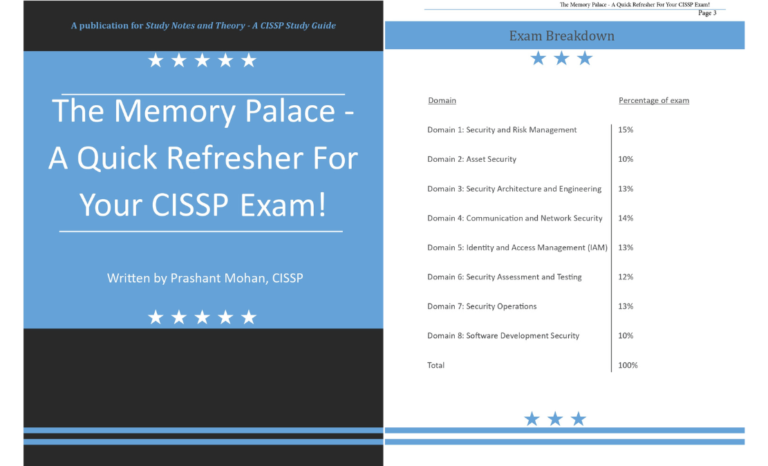
CISSP 8 Domains Cheat Sheet: Weights and Must-Know Concepts
Use this table alongside the PDF to see where the exam puts its weight and which concepts come up again and again. The percentages are the ISC2 domain weights in the current exam outline. ISC2 revises the outline every few years, so check the official page before your exam date.
| Domain | Weight | Concepts you must know cold |
|---|---|---|
| 1. Security & Risk Management | 16% | CIA triad, due care vs. due diligence, ALE = SLE × ARO, risk responses (avoid, transfer, mitigate, accept), BCP/BIA, (ISC)² Code of Ethics |
| 2. Asset Security | 10% | Data owner vs. custodian vs. steward, classification levels, data states (at rest, in transit, in use), data remanence and sanitization (clear, purge, destroy) |
| 3. Security Architecture & Engineering | 13% | Bell-LaPadula (confidentiality), Biba (integrity), Clark-Wilson, symmetric vs. asymmetric crypto, PKI, hashing, secure design principles |
| 4. Communication & Network Security | 13% | OSI model layers and their protocols, TLS, IPsec (AH vs. ESP), firewall types, VPNs, network segmentation, wireless security |
| 5. Identity & Access Management | 13% | Authentication factors, DAC / MAC / RBAC / ABAC, SSO and federation (SAML, OAuth, OIDC), Kerberos, identity lifecycle |
| 6. Security Assessment & Testing | 12% | Vulnerability scan vs. penetration test, SOC 1/2/3 reports, code review and testing types, log review, KPIs and KRIs |
| 7. Security Operations | 13% | Incident response steps, evidence handling and chain of custody, backup types, RTO / RPO / MTD, DR site types (hot, warm, cold) |
| 8. Software Development Security | 10% | Secure SDLC, OWASP Top 10, SAST vs. DAST, DevSecOps, change management, software maturity models |
CISSP Last-Minute Review Checklist
If your exam is in the next few days, these sheets work best as a last-minute review guide. Run through this checklist and go back to the sheet for any item you cannot explain in one sentence:
- Think like a manager, not a technician. The “best” answer usually protects people first, then follows policy and reduces business risk. It is rarely a quick technical fix.
- Know the formulas: SLE = Asset Value × Exposure Factor, and ALE = SLE × ARO.
- Tell the models apart: Bell-LaPadula is “no read up, no write down”. Biba is “no read down, no write up”.
- Recovery metrics: RPO is about how much data you can lose. RTO is about how fast you must be back. MTD is the absolute limit.
- Incident response order: detection → response → mitigation → reporting → recovery → remediation → lessons learned.
- Crypto basics: which algorithms are symmetric or asymmetric, what a digital signature proves, and which key encrypts and which decrypts.
How to Study with the Cheat Sheets
- Read one sheet a day after you finish the matching domain in your main study guide.
- Cover the sheet and explain it out loud. Anything you cannot explain is a weak spot to revisit.
- Do practice questions per domain and note which sheet each mistake belongs to.
- In the final week, review all 8 sheets in one sitting every day.
Frequently Asked Questions
Is a cheat sheet enough to pass the CISSP?
No. The sheets are a review and memory tool. Pair them with a full study guide and plenty of practice questions. They are most useful in the last two to three weeks before the exam.
What is the CISSP exam format?
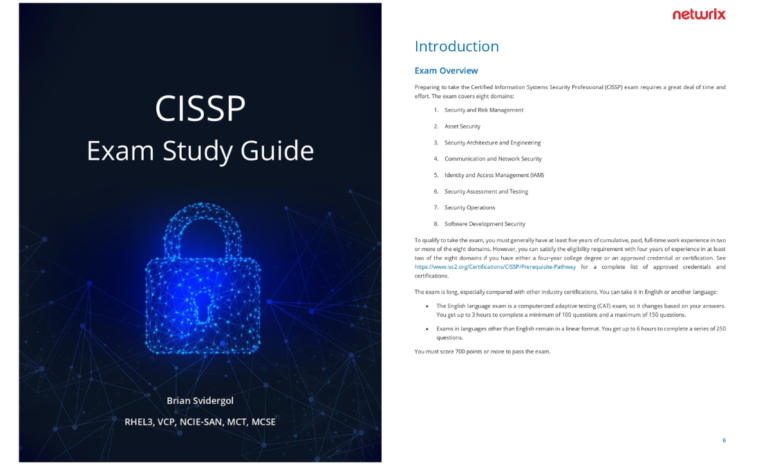
In English, the CISSP uses Computerized Adaptive Testing (CAT). You answer a variable number of questions within a fixed time limit, and you need a scaled score of 700 out of 1000 to pass. ISC2 updates the question count and duration from time to time, so confirm the current details on the official ISC2 website.
Which CISSP domain is the hardest?
Many candidates find Domain 3 (Security Architecture & Engineering) the hardest because of the cryptography and security models. Domain 1 carries the most weight. Use the sheets for these two domains more often than the rest.
Do I need work experience to get certified?
Full certification requires paid work experience in at least two of the eight domains. If you pass the exam without that experience, you can become an Associate of ISC2 while you gain it.
More Free CISSP Resources
- CISSP Exam Study Guide PDF: the full study guide to pair with these sheets
- CISSP Concepts Guide PDF
- CISSP Refresher Guide PDF
- CISSP Security Assessment and Testing (Domain 6) PDF
- CISSP Exam Preparation PDF
Download Your Free CISSP Cheat Sheet Series
Don’t waste time sifting through textbooks. Grab your PDF and study smarter:
🔗 Download the CISSP Cheat Sheet Series Now