

1. Introduction
In today’s data-driven world, the demand for skilled data scientists has never been higher. Whether you are a student stepping into the world of data science for the first time, a working professional looking to sharpen your skills, or a job seeker preparing for technical interviews, having access to the right learning material can make all the difference. The road to mastering data science is wide and sometimes overwhelming — it spans statistics, probability, machine learning, deep learning, SQL, and artificial intelligence. That is exactly why a resource like this one becomes invaluable.
The “Data Science Q&A: Comprehensive Guide to Questions and Answers” by Harsh Choudhary is a carefully crafted document that breaks down complex data science concepts into clear, digestible question-and-answer format. It is designed to be beginner-friendly while also challenging enough to satisfy the curiosity of advanced learners. In this blog post, we will walk you through everything this document offers, why it stands out, and how you can make the most of it.
2. Overview of the Document
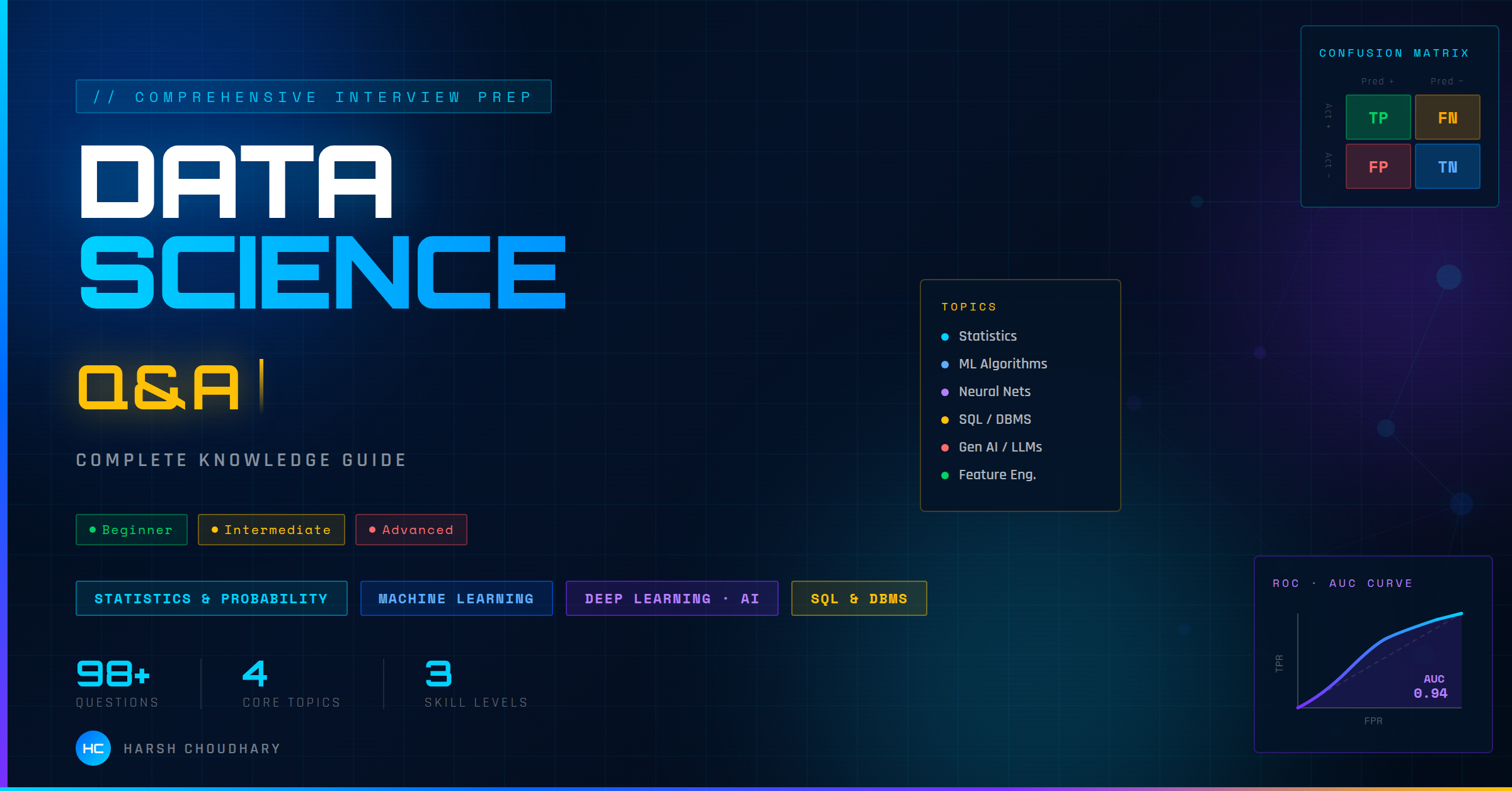
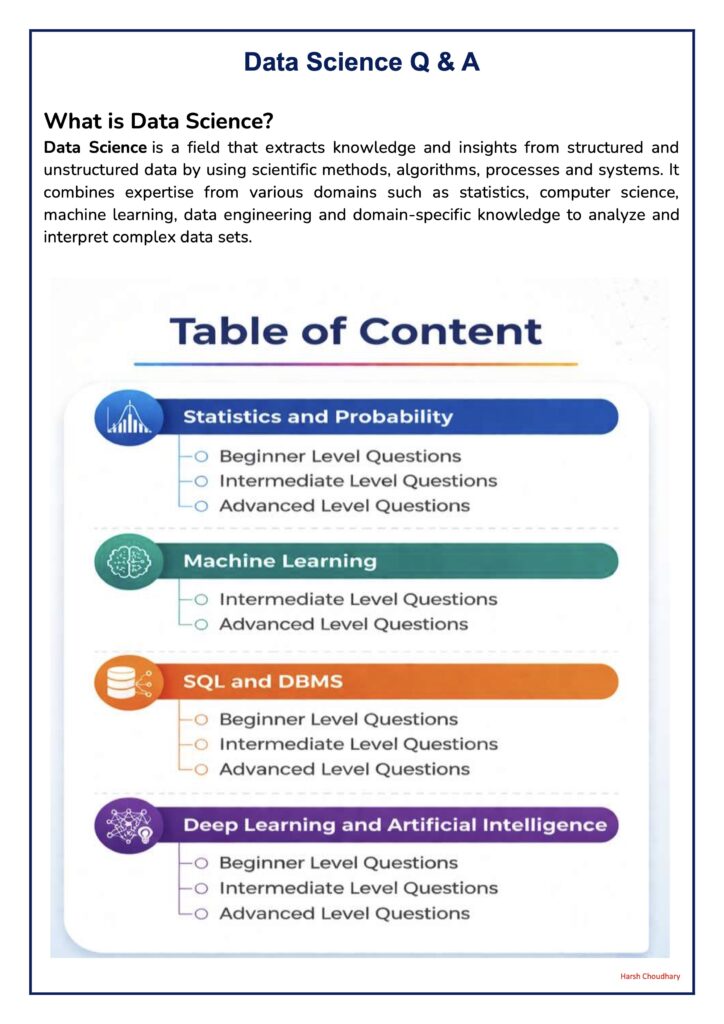
At its core, this document is a structured collection of 98 questions and answers spanning the most critical areas of data science. It is divided into four major sections, each progressing from beginner to advanced level:
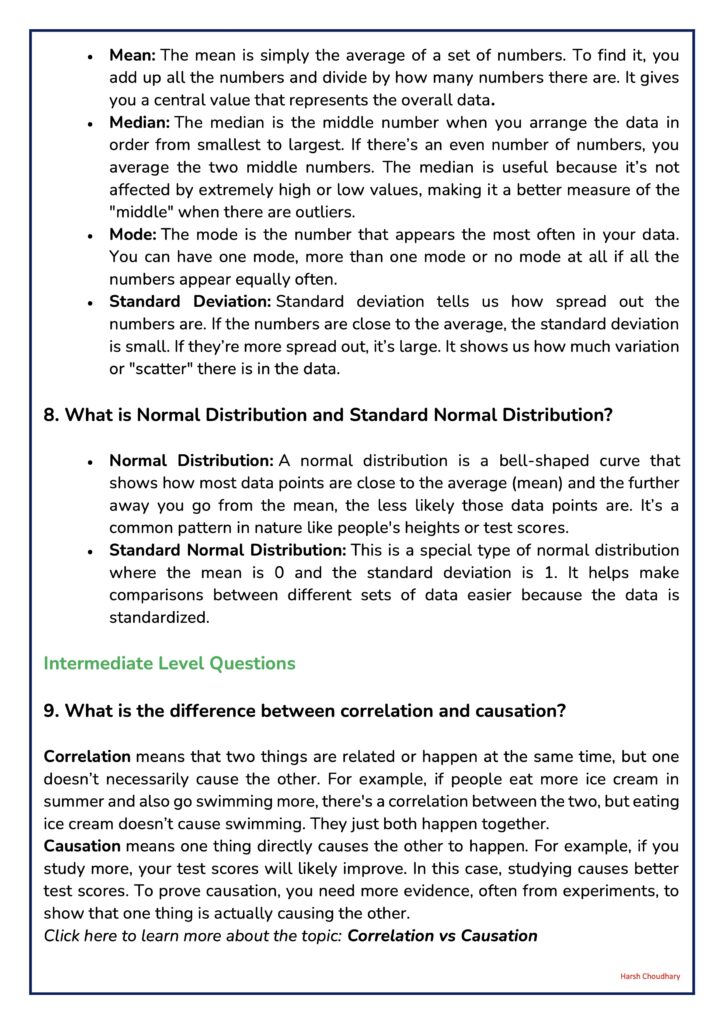
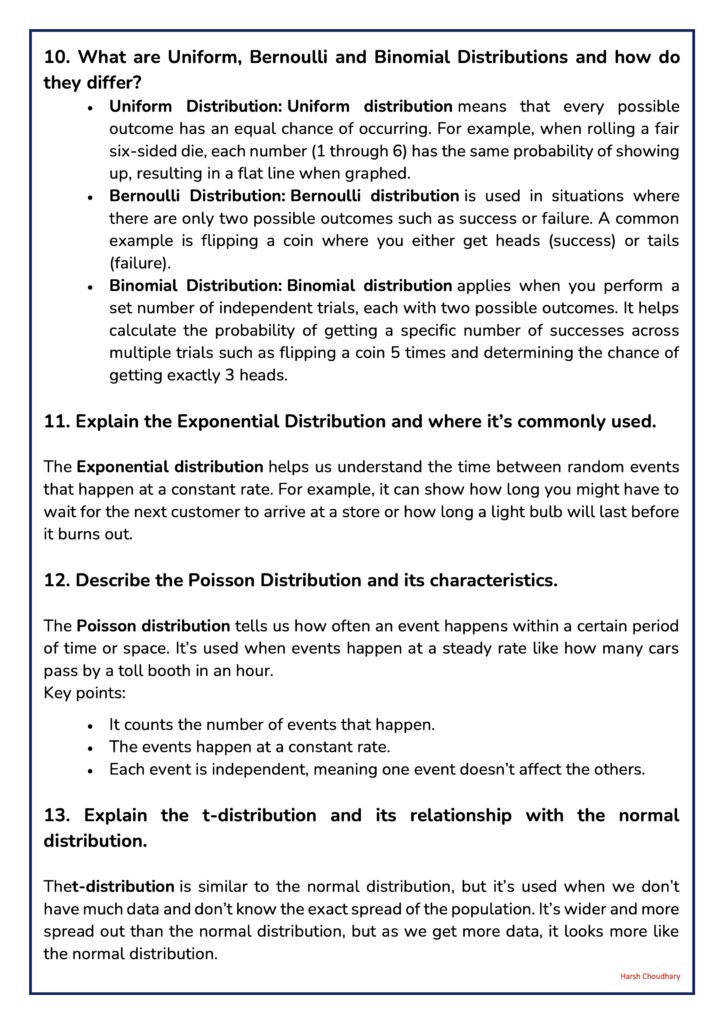
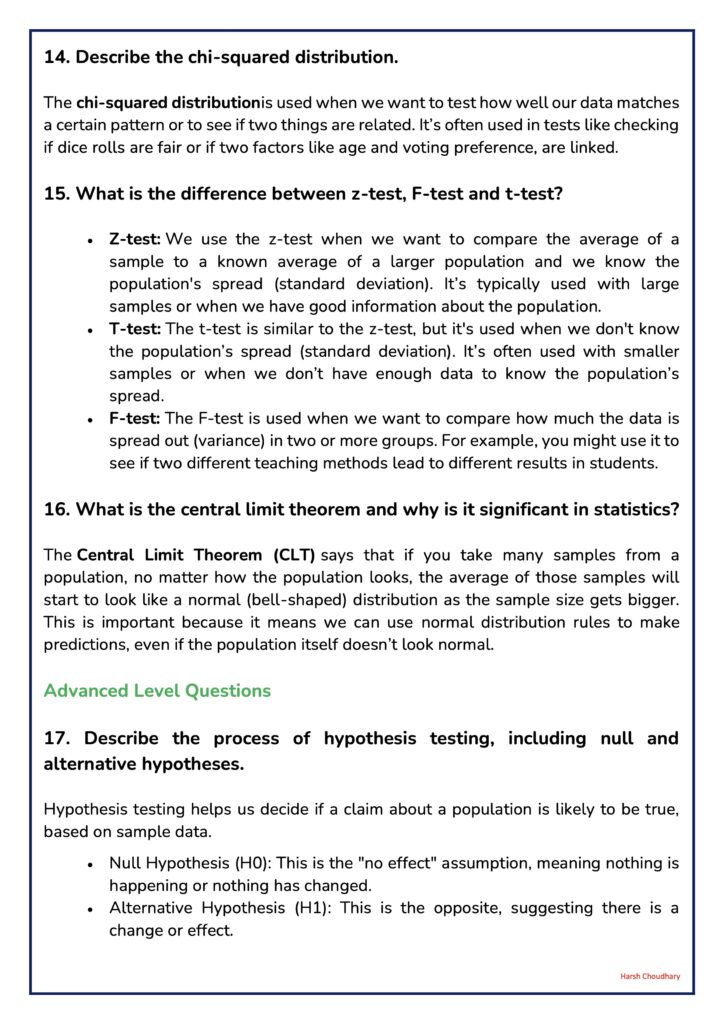
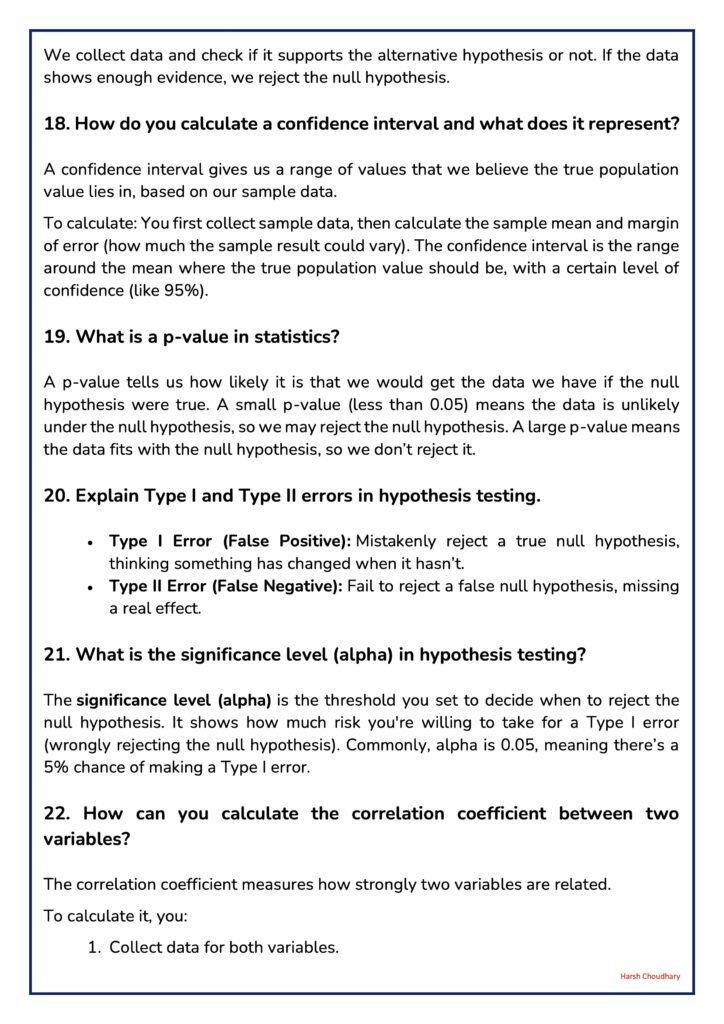
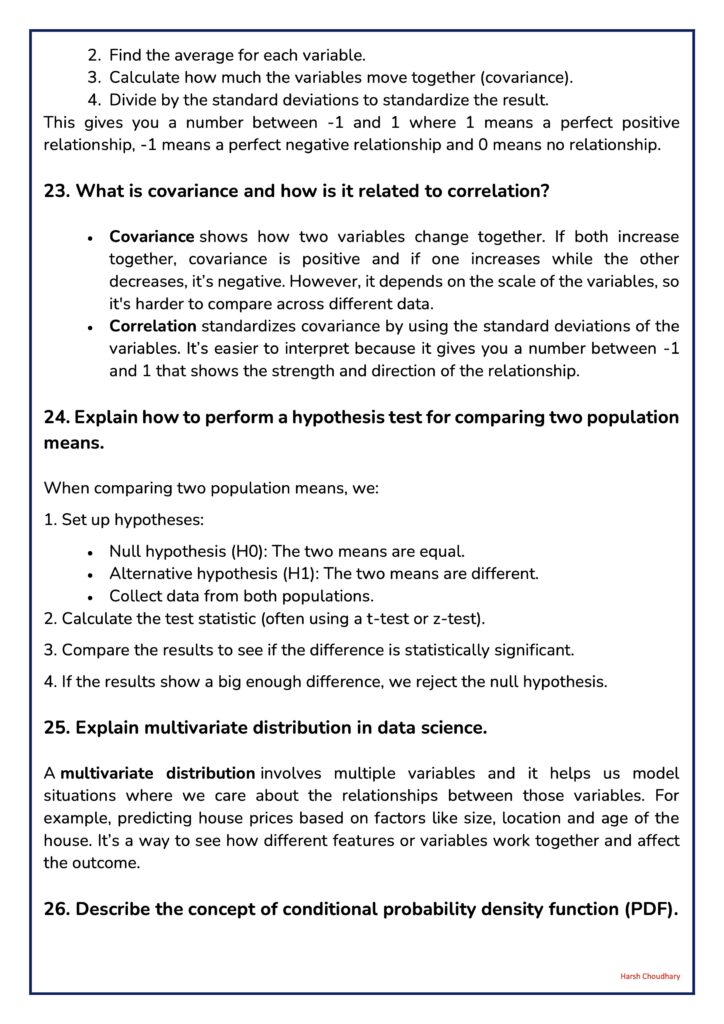
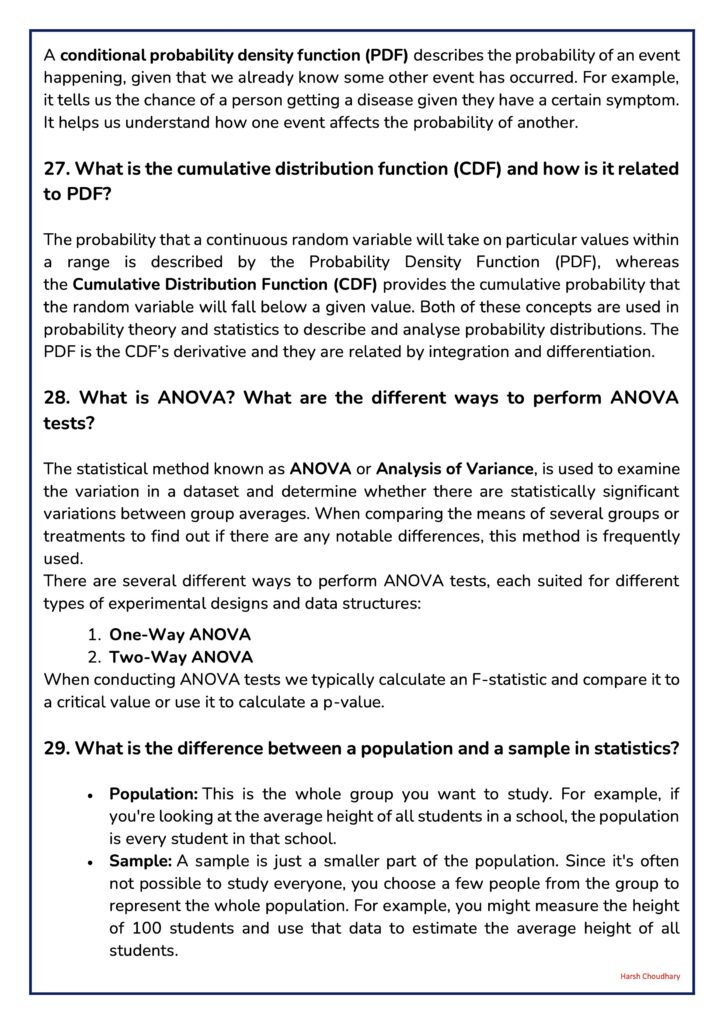
- Statistics and Probability — covering foundational concepts like marginal probability, Bayes’ Theorem, hypothesis testing, ANOVA, confidence intervals, and probability distributions.
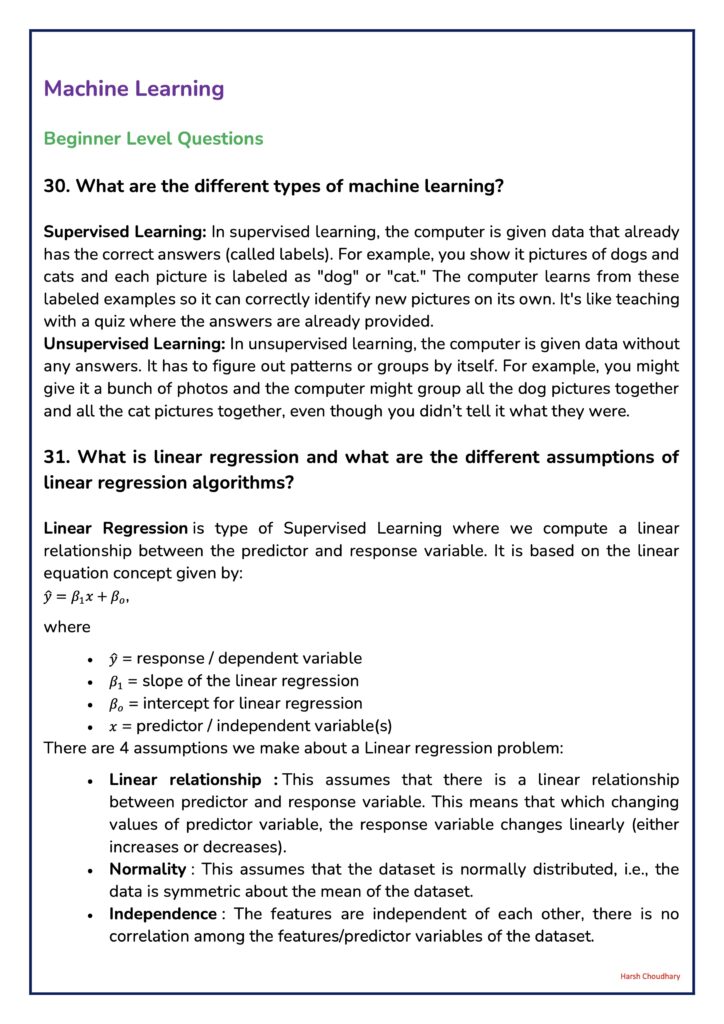
- Machine Learning — exploring supervised and unsupervised learning, algorithms like SVM, KNN, Random Forest, Gradient Boosting, and key concepts such as regularization, bias-variance tradeoff, and cross-validation.
- SQL and DBMS — addressing structured query language fundamentals, database design, normalization, window functions, joins, and the differences between SQL and NoSQL databases.
- Deep Learning and Artificial Intelligence — diving into CNN architectures, RNNs, GANs, transfer learning, NLP, word embeddings, Seq2Seq models, and Generative AI.
The document follows a clean, logical structure that allows readers to either read it from beginning to end or jump directly to the section most relevant to their needs. Each answer is written in plain language with supporting formulas, tables, and diagrams where appropriate, making technical topics far more approachable.
3. The Content
Statistics and Probability
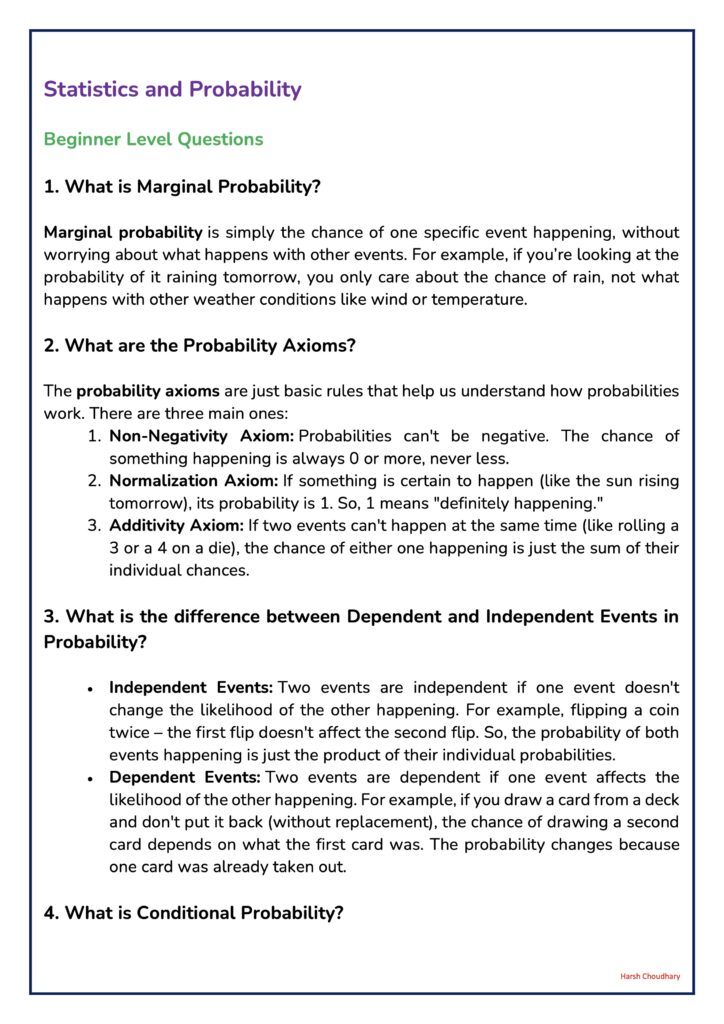
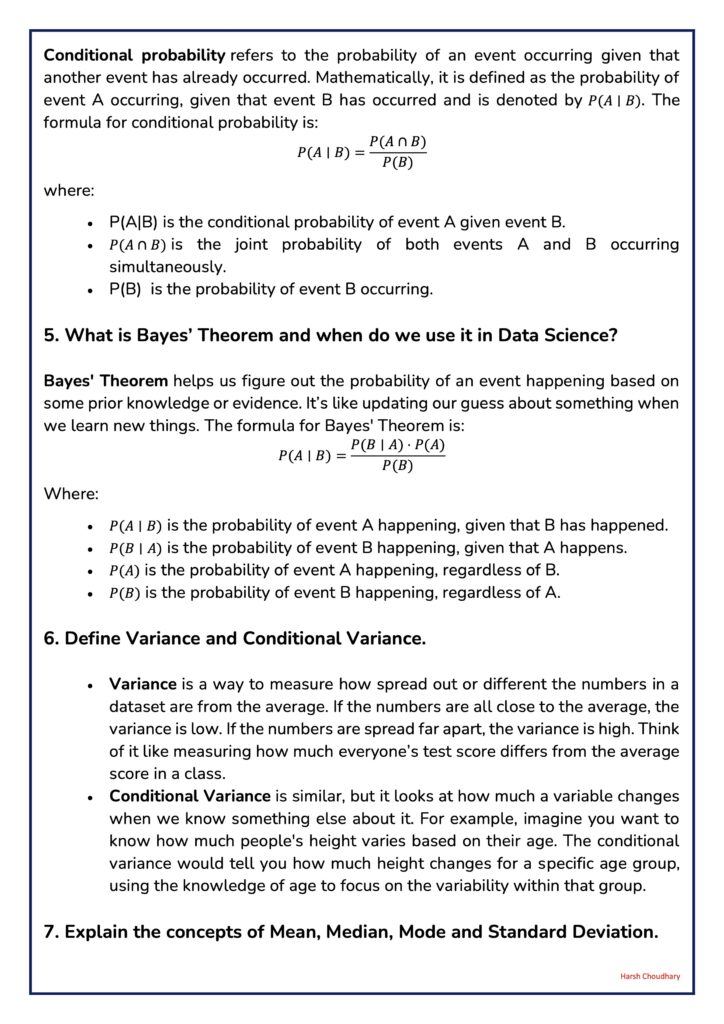
The document opens with the building blocks of data science — statistics and probability. Beginner questions introduce concepts such as marginal probability, probability axioms, dependent vs. independent events, conditional probability, Bayes’ Theorem, variance, and the differences between mean, median, mode, and standard deviation.
As the level increases, the questions venture into probability distributions including Uniform, Bernoulli, Binomial, Poisson, Exponential, t-distribution, and chi-squared distribution. At the advanced level, readers are guided through hypothesis testing, Type I and Type II errors, p-values, confidence intervals, correlation vs. causation, covariance, ANOVA, and multivariate distributions.
Machine Learning
The machine learning section is one of the most comprehensive parts of the document. It begins by distinguishing between supervised and unsupervised learning before walking readers through algorithms such as Linear Regression, Logistic Regression, Support Vector Machines, K-Nearest Neighbors, Naive Bayes, and Decision Trees.
Readers will also find in-depth explanations of ensemble methods like Random Forest, Bagging, and Boosting, as well as clustering techniques such as K-Means, DBSCAN, and the EM algorithm. Evaluation metrics including the confusion matrix, classification report, ROC-AUC curve, and silhouette score are covered thoroughly. Advanced topics include Gradient Descent variants, Feature Engineering, PCA, regularization (L1 and L2), and handling imbalanced datasets.
SQL and DBMS
The SQL section offers a solid grounding in database concepts. Beginners will find answers to questions about what SQL is, the differences between SQL and NoSQL, primary keys, ER models, and the main components of a SQL query. Intermediate questions explore GROUP BY, WHERE, HAVING clauses, and handling NULL values. Advanced topics cover normalization, denormalization, SQL functions, INNER JOIN vs. LEFT JOIN, window functions, subqueries, and the distinction between a database and a data warehouse.
Deep Learning and Artificial Intelligence
The final section takes readers into the frontier of modern AI. Topics include the convolution operations of CNNs, feedforward vs. recurrent neural networks, generative vs. discriminative models, forward and backward propagation, Markov models, and Generative AI. Advanced questions cover GAN architectures, VAEs, Transformers, Deep Reinforcement Learning, transfer learning, object detection vs. image segmentation, word embeddings, Seq2Seq models, and Artificial Neural Networks.
4. Why This Document?
There are dozens of data science textbooks and online courses available today, so what makes this particular document worth your time? Here are several compelling reasons:
Structured Learning Path: The document takes you from beginner to advanced level in each topic area systematically. You are never thrown into the deep end without proper context, making the learning curve manageable and rewarding.
Interview-Ready Format: The Q&A format mirrors real technical interview scenarios. By reading through and understanding each answer, you are essentially practicing how to articulate complex ideas clearly — a skill that is just as important as knowing the concepts themselves.
Broad Coverage in One Place: Instead of juggling multiple textbooks, tutorials, and websites, this single document covers all the major pillars of data science. Statistics, machine learning, SQL, and deep learning are all addressed under one roof.
Clarity Without Oversimplification: One of the biggest challenges in data science education is explaining complex topics without losing accuracy. This document manages to use simple, everyday language and analogies while still maintaining technical correctness. For example, explaining entropy as “a measure of how mixed or uncertain your data is” is intuitive without being misleading.
Visual Support: The document includes charts, diagrams, and tables — such as the Sigmoid function graph, the bias-variance tradeoff diagram, confusion matrix tables, and comparison tables between SQL and NoSQL — which significantly enhance understanding and retention.
Suitable for Multiple Audiences: Whether you are a university student, a bootcamp graduate, a self-taught programmer, or an experienced professional brushing up on concepts, this document speaks to all levels. The beginner, intermediate, and advanced labeling of questions allows you to pace yourself appropriately.
Free and Accessible Knowledge: High-quality educational content should be accessible to everyone. This document embodies that principle by compiling expert-level knowledge in a format that anyone can download and study at their own pace.
5. Conclusion
The “Data Science Q&A: Comprehensive Guide to Questions and Answers” by Harsh Choudhary is more than just a collection of interview questions — it is a roadmap for anyone serious about building or reinforcing their data science knowledge. It respects the reader’s intelligence while remaining approachable, covers the full breadth of data science disciplines, and presents information in a format that is immediately actionable whether you are preparing for an interview tomorrow or simply looking to deepen your understanding today.
Data science is not a destination but a continuous journey of learning. Resources like this document help make that journey more structured, more efficient, and ultimately more successful. If you are ready to take your data science skills to the next level, this guide is an excellent place to start — or to return to whenever you need a solid, reliable reference.
Do not wait to invest in your learning. Download the document, work through the questions section by section, test yourself, revisit difficult topics, and watch your confidence and competence grow with every page.
6. Download From the Below Link
You can download the full “Data Science Q&A: Comprehensive Guide to Questions and Answers” document for free using the link below. Start your journey toward data science mastery today — whether you are a beginner or an advanced practitioner, this guide has something valuable waiting for you.
[Download Now — Data Science Q&A: Comprehensive Guide to Questions and Answers]